The Kubernetes Project Governance
A Brief Analysis
Today, we will delve into the field of open source technology governance, specifically focusing on the Kubernetes Project community. Kubernetes is an open-source container orchestration platform that automates the deployment, scaling, and management of applications, used by more than 5 million developers around the world according to SlashData in 2021.
The Kubernetes Project community has a well-defined governance framework that provides insights into their operational approach thus far. The governance document is organized into various sections, outlining the key components and dimensions essential for effective project governance.
Our objective is to gain a deeper understanding of how technology governance functions in practical, real-world projects. To accomplish this, we will analyze the Kubernetes project governance by studying its original governance document, which is publicly available in the project's GitHub repository.
The Kubernetes Project Governance Dimensions and Components
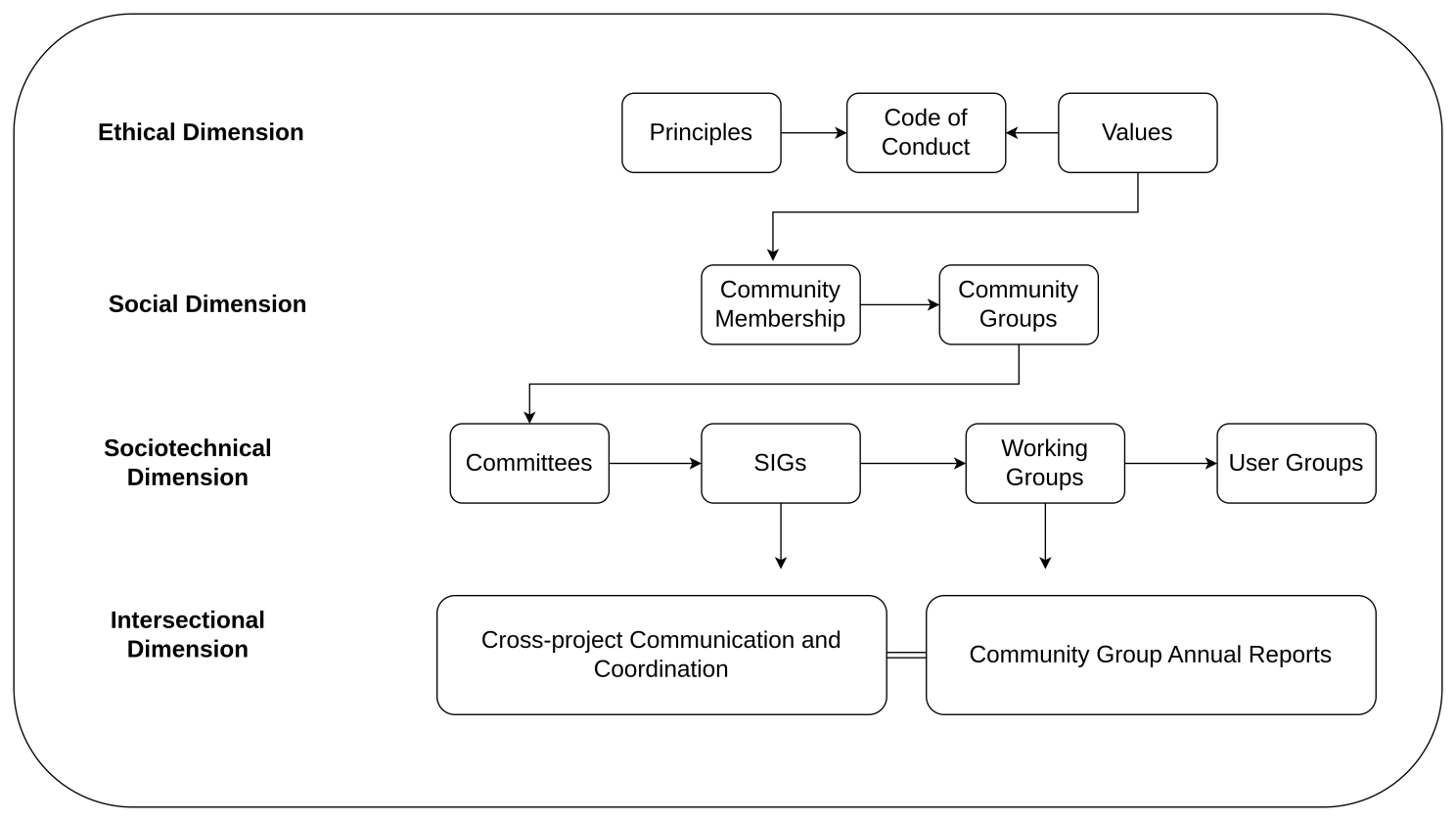 source: author
In the above diagram we can see the more general level components of Kubernetes Project Governance and its dimensions. Now we will see each of them and its relations between each other.
source: author
In the above diagram we can see the more general level components of Kubernetes Project Governance and its dimensions. Now we will see each of them and its relations between each other.
In the left we can identify 4 main dimensions composing the project governance landscape:
Ethical dimension; Social dimension; Sociotechnical dimension; Intersectional dimension.
The first dimension, says about the ethics of the project, it is like the project's head since it defines and highlights what is valued, what is expected from its members, what are the general symbols and meanings that drives the project.
The Social dimension is the connection between people and values as it delineates how people should become together in order to work on the project.
The third dimension makes a step further connecting people to technology, which means that the components on these dimension are observing the relations between members (people) and the creation and maintenance of the project.
The last dimension is the one which concerns with components which brings together the different groups of people working in the project.
Let's describe its main components and dimensions:
The Principles deals with the high level project principles since its Open Source principle until other ones such as: transparency, accessibility, merit. The Code of Conduct highlights the centrality of the community for the project and, therefore, the importance of following the culture and values for assuring a collaborative environment for the contributors. The Values highlights the overall community values as the keystone to the success of the project. They are: Distribution is better than centralization; Community over product or company; Automation over process; Inclusive is better than exclusive and Evolution is better than stagnation. The Community Membership outlines the different roles and responsibilities in the project distributed between: Member, Reviewer, Approver and Subproject Owner. The Community Groups is a sociological level that delineates the types of subgroups which compose the project as a whole: Special Interest Groups (SIGs); Working Groups (WGs); Committees and User Groups; The SIGs, Working Groups, Committees and User Groups sections defines the scope and attributions of each type of subgroup; The Community Group Annual Reports is the communicative moment between the chairs of each group and Steering Committee to align their works; The Cross-project Communication and Coordination delineates that work which cross its owner SIG domain needs to follow the guidelines for project-wide impact or cross-project communication and coordination, mostly defined at Kubernetes Enhancement Proposals (KEP); The Repository Guidelines reinforces as governance level rule the process outlined for all new project repositories on GitHub. CLA is the section which reinforces as governance level rule “the Contributor License Agreement” as pre-requisite for contribution on the project.
The Kubernetes Project Governance show us that in its case at least 4 general dimensions is fundamental for the project to work with a governance perspective observed by its members. That is why the four dimensions deals with these fundamental elements: values, people, connections between people, connections between people and technology and also the connection between the different groups of the project.
Through this analysis, we not only dissected and identified the core elements and dimensions of a globally impactful open-source project but also gained valuable insights. It becomes evident that governance primarily revolves around relationships and interconnections. It necessitates the careful observance of values and rules to ensure the continuity and future development of the focal technology